More than 2,500 years ago, a single human life transformed the spiritual geography of Asia forever. The places where the Buddha was born, attained enlightenment, gave his first teaching, and finally passed away remain among the most charged locations on the planet — and for the first time in centuries, all four are relatively accessible to a single traveller in a single journey.
This guide covers the Buddhist Pilgrimage Circuit in practical detail: what each site is, what to see, where to stay, and how to travel between them. Whether you are a practitioner of 20 years or someone who has only recently encountered the Dharma, this journey has the power to change something in you.
"There are four places, Ananda, which the faithful should visit with feelings of reverence and awe." — The Buddha, Mahaparinibbana Sutta
The Four Sacred Sites
The Buddha himself identified these four places. Each marks a turning point in his life — and in the history of human spirituality.
1. Bodhgaya — Where the Buddha Attained Enlightenment
Bodhgaya in Bihar is arguably the most important place in all of Buddhism. It was here, seated beneath a Bodhi tree (a descendant of which still stands today), that Siddhartha Gautama attained enlightenment after 49 days of meditation. The Mahabodhi Temple — a UNESCO World Heritage Site — rises 55 metres above the site of that awakening. It is one of the oldest brick structures in India, and the atmosphere around the Bodhi Tree at dawn, when monks and nuns from dozens of countries are doing prostrations or circumambulation, is unlike anywhere else on earth.
Bodhgaya hosts an extraordinary concentration of international Buddhist temples — from Japan, Thailand, Bhutan, Myanmar, China, Tibet, Sri Lanka, and more. Walking the main road at dawn feels like visiting all of Asia's Buddhist traditions simultaneously.

2. Sarnath — The First Teaching
After his enlightenment at Bodhgaya, the Buddha walked west to Sarnath, near Varanasi, where he delivered his first discourse — the Dhammacakkappavattana Sutta, Setting the Wheel of Dhamma in Motion — to five ascetics in the Deer Park. This is the moment Buddhism as a teaching tradition was born.
The Dhamek Stupa, an 8th-century cylindrical tower rising 34 metres, marks the exact spot of that first teaching. The surrounding archaeological park contains the ruins of monasteries that once housed thousands of monks. The Sarnath Museum houses the famous Lion Capital of Ashoka — now the national emblem of India — and the exquisite Gupta-period seated Buddha (5th century CE), considered one of the finest sculptures in Indian art history.
Varanasi itself deserves at least two days. The Ganges ghats at dawn — with smoke rising from Manikarnika cremation ghat, boatmen rowing in the early mist, priests performing the Ganga aarti — offer a profound encounter with the Hindu tradition that the Buddha grew up within, and later departed from.
3. Kushinagar — The Parinirvana
Kushinagar is where the Buddha, aged around 80, lay down between two sal trees and passed into Parinirvana — his final passing away. It is perhaps the most moving of the four sites precisely because of what is absent: the great teacher is truly gone here. The Mahaparinirvana Temple houses a magnificent 6-metre reclining Buddha dating from the 5th century CE, and the atmosphere inside — particularly when monks are chanting — is one of extraordinary stillness.
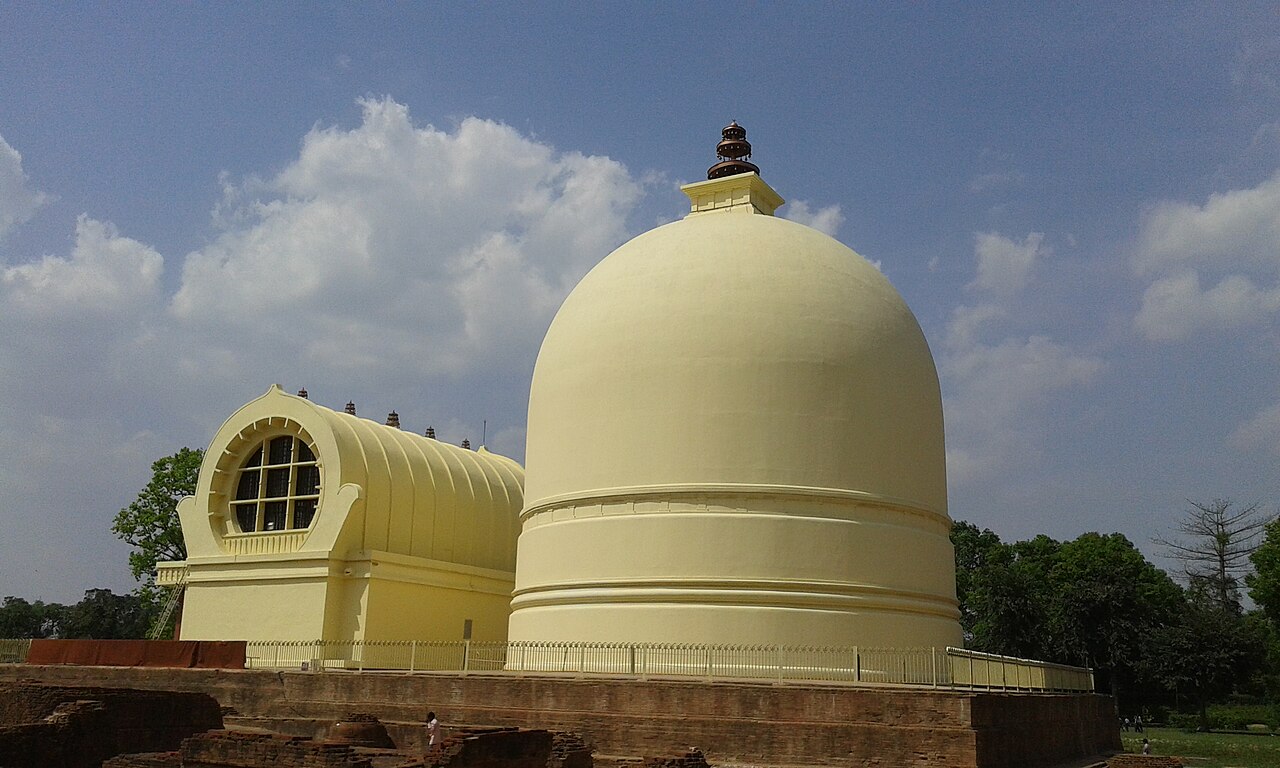
The Ramabhar Stupa, 1.5 km east of the Parinirvana Temple, marks the cremation site. It is a simpler, quieter place — a large brick dome in a grassy park — and many practitioners find it more moving than the main temple.
Kushinagar has grown significantly as a pilgrimage destination, with international temples from many Buddhist nations now surrounding the central archaeological zone. The town itself remains relatively quiet and unhurried — a relief after the intensity of Varanasi or Bodhgaya.

4. Lumbini, Nepal — The Birthplace
Lumbini is just across the Nepal border from Gorakhpur — a short journey from Kushinagar — and is the only one of the four sacred sites outside India. It was here, in a garden, that Queen Mayadevi gave birth to the child who would become the Buddha around 563 BCE. The Maya Devi Temple marks the exact spot, and the sacred pool nearby is where tradition says the infant was first bathed.
The Lumbini Development Zone — designed by Japanese architect Kenzo Tange — stretches for several kilometres and contains dozens of international Buddhist monasteries, each built in the architectural style of its home country. Walking from the Theravada zone to the Mahayana zone to the Vajrayana zone in a single afternoon is a remarkable experience of Buddhism's global diversity.
Practical Planning: When, How Long, What to Bring
Best overall season: October to March. The weather is cool and dry across the entire circuit. December–February is peak season with the highest number of teachings, visiting lamas, and fellow pilgrims. Avoid May–September (extreme heat and monsoon).
How long to allow: A minimum of 10 days to cover all four sites meaningfully. Three weeks allows for proper retreats or courses at one or two sites. A month, if you can manage it, is ideal — spend 5–7 days at each site and take it slowly.
Transport: The most practical route for independent travellers is by a combination of trains between major cities and hired taxis between smaller sites. Pre-booking AC sleeper trains is essential in peak season. Alternatively, several Buddhist travel operators offer guided circuit tours with private vehicles.
- Patna is the gateway airport for Bodhgaya (120 km)
- Varanasi Airport (VNS) serves Sarnath directly
- Gorakhpur is the nearest rail hub for both Kushinagar (55 km) and Lumbini (110 km)
- Kushinagar International Airport (KBK) now has direct flights from Delhi
What to bring: Modest clothing (arms and legs covered) is expected at all temple sites. A shawl or light jacket for evening meditation, a head covering for some temples, a journal, and an open mind. Leave behind the itinerary mentality — the circuit rewards slow travel more than checklist tourism.
"May all beings be happy. May all beings be free from suffering." — Metta Sutta
Beyond the Four: Extending the Circuit
The four main sites are just the beginning. Within a few hours of the circuit, several other important Buddhist places are worth including if time allows: Rajgir (where the Buddha gave many teachings including the Heart Sutra, 100 km from Bodhgaya), Nalanda (the great monastic university, 90 km from Bodhgaya), and Sravasti (where the Buddha spent 25 rainy seasons, 170 km from Kushinagar).
For those wishing to combine the pilgrimage with a deep meditation retreat, we recommend arriving at Bodhgaya early in the season (October) to complete a 10-day Vipassana course at Dhamma Bodhi, followed by the pilgrimage, with a final stay at Root Institute for Wisdom Culture. The retreat at the start creates an inner stillness that makes the external sites far more meaningful.