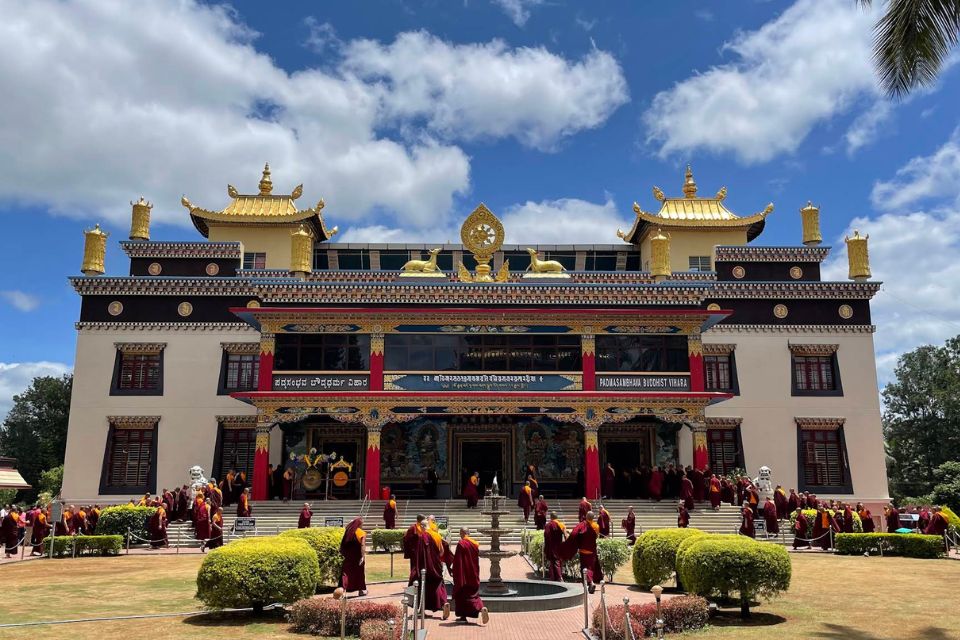


About Namdroling
Namdroling Monastery is the seat of the Palyul lineage of the Nyingma school of Tibetan Buddhism — and the largest Nyingma center in the world outside of Tibet. Situated in the Tibetan exile settlement of Bylakuppe in Karnataka, it was founded in 1963 by His Holiness Pema Norbu Rinpoche (Penor Rinpoche, 1932–2009), who fled Tibet after the Chinese occupation and painstakingly re-established the full Palyul monastic tradition on Indian soil. Today, with over 9,000 monks and nuns registered and 3,500 resident at any given time, Namdroling is the heartbeat of the living Nyingma tradition outside Tibet.
The jewel of the monastery is the Namdroling Golden Temple — formally the Zangdog Palri Phodrang, or Palace of Lotus Light — inaugurated in 1999. Its golden walls, multi-tiered architecture and 20-foot gilded statues of Guru Padmasambhava, Amitayus and Chenrezig are among the most breathtaking examples of Tibetan sacred art in the world. The complex also includes the Namdroling Stupa and the Shedra (monastic university), where monks study the nine yanas of Tibetan Buddhism over a twelve-year curriculum.
Visitors can stay in the monastery's guest house, participate in morning and evening pujas, explore the temple art at their own pace, and experience the extraordinary sight of thousands of monks and novices in daily practice. The surrounding Tibetan settlement at Bylakuppe — with its Tibetan homes, craft shops, and restaurants serving authentic momos and butter tea — makes this a deeply immersive cultural encounter.
Experiences at Namdroling
Practical Information
- Temple etiquette: Remove footwear before entering. Walk clockwise (circumambulate) around stupas and temples. Do not touch statues, paintings or sacred objects. Maintain silence inside the assembly halls. Modest dress required (cover shoulders and knees).
- Photography: Photography of the exterior is generally permitted. Ask permission before photographing inside temples, especially during pujas. Never photograph monks or nuns without consent.
- Guest accommodation: The monastery guest house (Paljor Dhergyaling) offers simple rooms. Advance booking is strongly recommended, particularly during Tibetan festivals and winter months when the monastery is busiest.
- Getting there: Bylakuppe is 6 km from Kushalnagar on the Mysore-Coorg highway (NH-275). Taxis from Mysuru take approximately 2 hours. The nearest railway station is Mysuru Junction. State-run KSRTC buses connect from Mysuru bus stand to Kushalnagar.
About the Lineage
Namdroling is the global seat of the Palyul lineage — one of the six major mother monasteries of the Nyingma school. The Palyul lineage traces its transmission directly to Padmasambhava (Guru Rinpoche), the great 8th-century tantric master who brought Vajrayana Buddhism to Tibet. Its most sacred practices centre on the Namchö (Sky Dharma) treasure-cycle revealed by Migyur Dorje in the 17th century, which includes the famous Dzogchen practice of Tukdrub Barché Kunsel — the heart-practice of the Palyul school.
H.H. Pema Norbu Rinpoche (Penor Rinpoche), 11th throne holder of the Palyul lineage, established Namdroling in 1963 with a handful of refugee monks and a handful of rupees. Over six decades he built it into a world-renowned institution with over 9,000 monastics, a full-scale shedra (monastic university), retreat centres, and branch monasteries across Asia and the West. Before his passing in 2009, he was widely considered one of the greatest living masters of Tibetan Buddhism. The current throne holder is H.H. Karma Kuchen Rinpoche.
What Visitors Say
Nothing in India prepares you for your first sight of the Golden Temple. We arrived at dusk, the golden spires caught the last light, and the sound of conch shells from inside announced the evening puja. We sat in the back of the assembly hall for an hour listening to 300 monks chant. My husband and I both cried. We will be going back.
The guest house is basic but very clean and the monks are extraordinarily welcoming to lay visitors. Walking through the Tibetan settlement and eating dal and momos at one of the small restaurants was its own kind of quiet meditation. The temple art is breathtaking — I spent an entire morning just sitting and looking at the ceiling. Deeply recommended.